|
| Seagulls on the border fence (fron Tijuana side) |
I went to San Diego with Tijuana on my mind. The most
important thing was to see my family and celebrate Thanksgiving with them in
San Diego, of course. But I wanted, if just for a day, to cross over to the
westernmost city in Mexico—and in all of Latin America—and report back on what
I found there.
I had some guidance from a friend in Indianapolis, Daniel
Del Real, a visual artist and director of Nopal Cultural, a cultural arts
organization dedicated to promoting Latino-American arts and culture in
Indianapolis and surrounding cities. I met him at El Maguey Restaurant on 38th
Street on Indy’s west side, a few days before my departure for San Diego, in
order to conjure up an itinerary. Over beer and Mexican food, Del Real let me
know that he had been born in Tijuana and spent the first year and a half of
his life there.

A little farther from the beach, we could see even more embellishments to the fence.


I was beginning to wonder if I was ever going to get to see this gallery. Was it a mistake to bring these dudes along on my quixotic quest to see as much of TJ in one day as possible? Was I just tilting at windmills? Fortunately there was a tourist information booth right on the avenue and the twentysomething guide was very helpful. He brought out a map inside a tourist brochure in the shape of a passport, “pasaporte a los mejores lugares de Tijuana, B.C.”
After about ten minutes, Arturo Rodriguez, the thirtysomething
founder and director of La Caja Galley arrived.
I asked him if I could talk to him about his gallery and he obliged.
“This is a very young city; it is 126 years old,” he said. “Nobody did any urban planning. That’s the reason this city has grown this much. This is a city that has the most growth in the world. There’s a lot of immigration here. There’s a lot of people coming into Tijuana, they’re not able to cross into the United States. So Tijuana has grown tremendously.”


“My dad would play accordion around the bars,” he told me.
Del Real moved to Southern California when he was a toddler.
He arrived in Indianapolis when he was 13 years old. He’s 32 now.
He has yet to be back, however. He keeps in touch with that
city, and by extension all of Mexico, through his appreciation of musicians
based in Tijuana, including Maria y Jose and Julieta Venegas.
“I know the one thing to do as a tourist is to get on the
donkeys and get a photo taken,” he told me.
I told him this suggestion wouldn’t make the tip top of my
to-do list. I also told him that I had been to TJ once before 15 years
previously with my father. We’d gone to the Museo de las Americas, a museum
that—in my humble opinion at least—puts the San Diego Natural History Museum to
shame. The Tijuana Wax Museum, which we also visited, wasn’t quite so
impressive (although the Michael Jackson figure was pretty convincing). I was,
however, looking for a more current measure of its cultural scene.
“I know that if you go to the beach, right by the border,
Las Playas de Tijuana, you’ll find something,” Del Real said. “This artist
painted the border to make it look like it’s not there. So on a really nice day
it actually blends in with the background and it looks like a gateway to get
through the border.”
Del Real also told me that he wouldn’t cross the border
alone. Accordingly, I made a few inquiries.
A week later, my sister drove me down to the border along with
two of her fifty-something friends; Bill Anderson and her significant other. I’ll
just call the latter dude The Greg. Ali
dropped us off at the San Ysidro border crossing—the world’s busiest land crossing—and
then circled back to my parents’ house in La Jolla, where she would spend the
day with my daughter, Naomi.
Bill, Greg, and I would be crossing as pedestrians.
I should say a little about The Greg. He, like Anderson, was from Ali’s hometown of Laramie, Wyoming.
(We were all in town to celebrate Thanksgiving with my parents.) The Greg was a
U.S. government consultant with a pretty liberal mindset, aside from his
hardcore 2nd amendment beliefs.
I had a taste of these beliefs on the drive down to the
border from San Diego as we passed a highway sign reading “GUNS ILLEGAL IN
MEXICO.”
This sign seemed to irk Greg so quite naturally I brought up
a certain news story. It was a widely disseminated story, especially on right
wing talk radio, about a marine who claimed that he had made a wrong turn when he rolled into Mexico carrying guns in his truck. Not coincidentally, he then found
himself in a Mexican prison.
“So,” said Greg, “What’s your point?”
I was tempted to say something about Mexicans having the
right to their own laws as they have their own problems with gun violence, but
I recalled that my sister had warned me to stay away from engaging Greg on this
subject. And since Ali was at the wheel driving, I didn’t want to distract her.
I also didn’t want her accidentally making a wrong turn. And it was a very easy thing to do at this
juncture of I-5, to make a wrong turn and wind up in the one-way-only flow of
cars into Mexico.
Bill, thank God, was more easygoing than Greg. He made a
living in Laramie specializing in house-sitting and taking care of people’s
pets. I thought he might appreciate the art scene in TJ: I thought that he
might appreciate it through the lens of having lived in New York City during
the early 80s. He seemed as excited as I was about this trip; Ali had somehow
persuaded him that I was some kind of famous journalist (instead of the
part-time freelancer that I am).
 |
| Bill, the Greg, and me |
Bill, Greg, and I followed the pedestrian walkway into
Mexico. Once across, we took a taxi straight to Las Playas de Tijuana (the moniker
for the westernmost district of Tijuana as well as the beach itself)
 We
stepped out of the taxi within sight of the border fence. It consisted of a long
line of 21-foot-high steel rails standing inches apart from one-another, and
which penetrated 300 feet into the Pacific.
We
stepped out of the taxi within sight of the border fence. It consisted of a long
line of 21-foot-high steel rails standing inches apart from one-another, and
which penetrated 300 feet into the Pacific.

It was a warm, mild day. Cloudless sky.
Looking eastward, we could see the fence stretching eastward
into the hills as far as the eye could see.
The most striking thing, though, was the part of the fence
that Daniel Del Real had told me about.
Indeed, a 12-foot-wide section of the fence, right on the
beach, was painted blue, sky blue. I knew, through online research, that this was
the work of artist Ana Teresa Fernández. And as the sky that day was itself a
perfect shade of blue, it was just possible to imagine that that part of the
fence had evaporated and that you could simply walk across from Tijuana into
San Diego.
Fernández, who first painted the fence in 2011 and has been back
four times to repaint, was born in Tampico, Mexico and currently teaches in the
California College of the Arts in San Francisco. She combines performance into
her work as a visual artist, and she documents these performances through photography,
video, and painting.
One of her paintings, available for view on her website, is
a self-portrait. In this painting, entitled “Erasing the Border,” you see her
painting the fence in a black cocktail dress and pumps, using a ladder. She
was, in fact, wearing this outfit while painting the fence, and her
painting was just one way in which she documented her “performance,” as she
calls it.A little farther from the beach, we could see even more embellishments to the fence.
There was a section
painted with the names of Mexican veterans of the American armed forces who had been deported from the U.S
and then there was the upside down American flag with crosses instead of stars
representing those who had died crossing into the United States.

If you don’t don’t come from an immigrant background
yourself (or, should I say, a recent immigration background), it may be easy to
see border issues as primarily issues of national security. But when viewing the border fence from the Tijuana side of the border–and trying to get a sense of the Mexican perspective on it - you must, just for starters, take into account the consequences of a fortified border.
As urban crossings have become more difficult over the last
two decades, more and more crossings have taken place in remote desert areas.
In such places, the border fence isn’t well-fortified or doesn’t exist. So it’s
easy enough to make the initial crossing. But it’s not so easy to survive the
trek through the deserts on the American side where hundreds of Mexican
nationals die each year of dehydration and heatstroke.
The Unites States isn’t an innocent bystander in all this. Around
the time when the urban border areas started being fortified in earnest—the
mid-nineties— the North American Free Trade Agreement (NAFTA) went into effect
between the U.S. and Mexico. NAFTA devastated small farming in Mexico and thus increased
the economic incentive to immigrate to the U.S.
I confess, however, that immigration issues were not so much
on my mind on the Tijuana beach. Instead
I was struck by the beauty of the place.
“Look at the gulls, gotta get a picture of the gulls,” Greg
said, pointing out that the seagulls sitting on the fence rails, stretching out
to sea. And these seagulls, of course, didn’t need any visas or passports or
green cards to cross.
So I took pictures of the gulls.
Bill, on the other hand, was interested in taking pictures
of me.
“You popped right down here and ran down the embankment,”
Bill said. “And it was a great picture, what you were heading out to do,
instead of walking down because you were so excited. But I’d like to get that
picture.”
That is, he wanted to have the opportunity to take that
picture of me coming down to the beach with his iPhone. I obliged him, staging
a do-over of my entry onto the Tijuana beach. Maybe I was afraid that if my
coming to Tijuana wasn’t captured digitally, there might be some question about
whether or not it happened at all.
I thought, then, about Ana Teresa Fernández in the context
of this question. The world wouldn’t have noticed her magic trick with the border
fence if she hadn’t obsessively documented it in video, painting and
photographs. Indeed, news organizations in the U.S., in Mexico, and in Europe, have run stories on her work as an artist.
A young man ran past me on the sand, running towards the
border fence. An older man was timing
him with a stopwatch. Once the young, stocky man reached the border fence, he
sprinted again and then stopped beside the older man. He stood, then, kneeling
with his hands on his knees.
I went up to them and asked who they were and what they were
doing. By asking in English, I managed
to ascertain that the guy doing sprints was the goalkeeper for the Baja
California fútbol (soccer) team; the other was his coach. I wasn’t able,
however, to have an actual conversation.
My goal on this trip was to know enough Spanish to get
around before crossing the border. But
there hadn’t been enough time.
My parents moved out to San Diego 15 years ago. At that time
I had been accepted into the M.F.A program in Writing at San Diego State University.
I could have, if I so desired, chosen to go to SDSU and lived with my parents
for a while, saving on room and board.
Instead, I chose to pursue a Master’s Degree in nonprofit management at
IUPUI (I also got married and had a child). Though I know I made the right
choice, I suppose my obsession with Tijuana and learning Spanish has to do with
what Robert Frost talks about in his poem, “The Road Not Taken.” Because I know
if I had moved out to San Diego, I would have probably spent a lot of time
exploring the border.
And I would’ve probably written about it as well.
Yet in my day job in a management team in an Indianapolis
Goodwill retail store, I encounter people on a daily basis whose Spanish is
better than their English. So I’d like to be able to be able to communicate
clearly to my customers.
Better communication probably wasn’t what Sarah Palin had in
mind, when she contended recently on national television that we should all
“speak American” in the United States. But just consider the fact that the
Spanish were in the U.S. before the Pilgrims. Consider also the fact that much
of the Western United States was forcefully acquired from Mexico. How can
anybody say that Spanish is less an American language than English?
As Greg, Bill and I walked up along the fence from the beach
we passed an international children’s garden that stretched across the border
into the United States. The garden was part of Friendship Park (on the Tijuana
side known as El Parque de la Amistad) a binational park where residents of
both countries can come to talk to one another. And families can reunite for a
few hours, through the grill of a wire fence, to talk to loved ones.
On Sundays there is even a “Border Church” an ecumenical
service that takes place simultaneously on both sides of the border. (The
pastors on each side of the border translate each other’s sentences for their
assembled crowds.) Unfortunately the park is only open on the U.S side from
Saturdays and Sundays from 10 a.m. to 2 p.m., the only times that U.S.
residents are allowed to approach the border fence.
There were some rocks painted with the phrase: “Paz y amore
en los corazones de todo el mundo.” (Peace and love in the hearts of all)
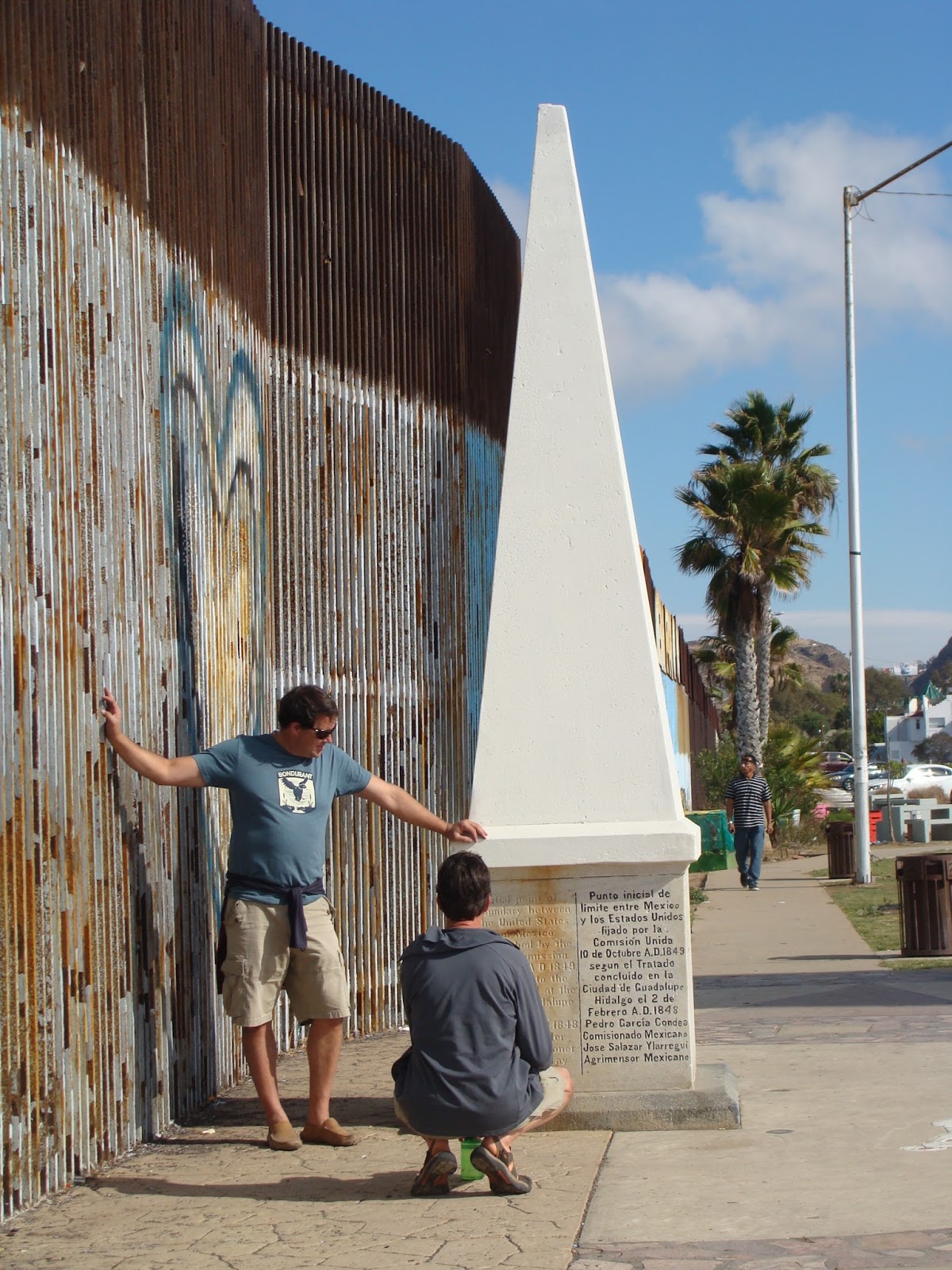
We passed boundary monument # 258, 14 feet high and made of
Italian marble, placed at the spot in 1849, in the wake of the signing of the
Treaty of Guadalupe Hidalgo, which ended the Mexican-American War (and put more
than 500,000 square miles of Mexican territory in U.S. hands).

In another section the fence had been painted - again by Ana Teresa Fernández - with the word
“EMPATHY.” In another it had been painted with the phrase “SOMOS AMERICA,” as
if to raise the make the point that the border is much more a political one
than a cultural one.
It was hard to look at the border fence without taking into
account Donald Trump’s openly racist call to extend it the entire length of the
border and deport 11 million undocumented. But The Greg kind of made it impossible not to think of these things by
pulling his hair forward over his eyes and posing as Donald Trump so Bill and I
could photograph him.

It was time to move on.
In our walk up from the beach, we encountered an engaging
mural by Búho Villamil, a Tijuana-based artist. His mural featured a man riding
a snail with photorealistic (or perhaps I should say photosurrealistic) detail. This being the Internet age, he encouraged
visitors to contact him not by snail mail, but on Facebook. (I would discover
later that Villamil was, like Ana Teresa Fernández, a performance artist as
well as a painter.)
 |
| mural by Búho Villamil |
It was approaching noon and we were all hungry. So we
stopped into a restaurant about half a block up the street from the shore, a
restaurant called El Fara. The most notable thing about the restaurant on first approach was its
insanely steep ramp for wheelchair access.

Both Bill and Greg ordered the seafood cerviche salad and beers while I ordered the scrambled eggs and shrimp. The plates came out quickly: the portions were huge and everything was fresh. Comparable plates would have been difficult to find on the U.S. border—and impossible to match pricewise—at around four dollars a plate.
Greg was absorbed in the soccer game on TV. Barcelona was
smearing Rome, six to one. My mind
wandered as it often does while watching sports on TV. I thought about recent reports of corruption
in FIFA (Fédération Internationale de Football). Then I thought about how Colts owner Jim Irsay leaned on the city of Indianapolis in order to fund the construction of Lucas Oil Stadium - at a cost of 720 million with 86 percent of this cost borne by the public, according to USA Today.
Both Bill and Greg ordered the seafood cerviche salad and beers while I ordered the scrambled eggs and shrimp. The plates came out quickly: the portions were huge and everything was fresh. Comparable plates would have been difficult to find on the U.S. border—and impossible to match pricewise—at around four dollars a plate.
 |
| Building in Las Playas de Tijuana |

(Several days after our TJ trip, the Nov. 26 edition of The
San Diego Reader would come out with a cover story highlighting what they characterize as Jim Irsay’s
hard-partying, pill -popping, extortionate reign in Indy as part of a series on
NFL owners.)
I had one particular destination in mind. We flagged down a taxi to
take us to a gallery that I had read about in the Los Angeles Times: La Caja Gallery. This was a gallery, according to the Oct. 30 article by Carolina A.
Miranda, at the heart of an art renaissance taking place in the heart of
Tijuana.
I had written down the address or what passed for an address
off the Avenida Revolución, the most famous avenue in all of the city – a big
draw for American tourists with its plentiful bars, shops, nightclubs, and brothels.
How hard could the gallery be to find? Even with the help of his smartphone,
however, our taxi driver was unable to locate it. So he just gave up and
dropped us off in front of a casino that the Greg was drawn to like a moth to a
flame.
Just as we were considering a foray into the casino, a
military jeep passed. Standing on the back was a soldier wearing a ski mask,
clutching a gun turret, a reminder that the drug wars were far from over in
Mexico.I was beginning to wonder if I was ever going to get to see this gallery. Was it a mistake to bring these dudes along on my quixotic quest to see as much of TJ in one day as possible? Was I just tilting at windmills? Fortunately there was a tourist information booth right on the avenue and the twentysomething guide was very helpful. He brought out a map inside a tourist brochure in the shape of a passport, “pasaporte a los mejores lugares de Tijuana, B.C.”
So we took another taxi. We spent the next half hour or so
crisscrossing over defunct railroad tracks and through the various warehouse
districts of Tijuana. By this time I could tell that Greg and Bill were getting
tired of all this. Our taxi driver though, was incredibly patient, and he
stopped at a hardware store to ask directions.
We drove a little more. Then we came upon, of all things, a
frame shop. I figured this was a good place to ask directions. Indeed the clerk
knew the whereabouts of the gallery. Shortly thereafter our taxi pulled up in
front of a warehouse-size building covered with swirling, surrealistic
murals.
We got out of the taxi. I knocked on the door. Nothing.
Nada. Then I rang the doorbell. Still nada. Was this trip through the
industrial areas of TJ all for naught? This residential/industrial area probably wasn’t
the best part of TJ to wait around for someone to come and by chance open the
door.
Just as I was about to beat myself up for not making an
appointment – after all, La Caja Gallery had a web address with contact
information – a young woman walked up. She was the accountant.
The woman cheerfully let us into the building. The door
opened into a room that served as both a gallery and a classroom with chairs
and desks and paintings on the walls.
The accountant’s broken English—much better than my Spanish—didn’t make
for easy conversation.
I noticed a curious painting on the first floor. It featured
a mixed media painting of Alice—the Wonderland Alice—against a backdrop that was
all hard edge abstraction à la Frank Stella with its bold colors and geometric
patterns. Entitled simply “Alicia,” it
seemed equally geometric in the sense that it was a line drawing with more in
common with cartoon draftsmanship than classical portraiture. Curiouser and curiouser, I thought.
The young accountant took us through the looking glass, as
it were, and showed us into a gallery where there was a show featuring textural
paintings that one could touch. The show was entitled “Paisaje Interno,” and
was designed especially for the blind so they too could appreciate art. There was also a fog machine with a sound system was also a fog machine and a sound system. She took upstairs and showed us around the two distinctly different exhibitions on view there.
In fact, talking about his gallery to American reporters is
something he’s been doing quite a lot recently. We sat down, both on plush
couches facing one another; on the table between us was the Los Angeles Times
edition featuring La Caja as well as other galleries and arts organizations
involved in the thriving Tijuana arts scene.
Rodriguez stepped back in time to give a context to his
gallery’s place in the sprawling metropolis. “This is a very young city; it is 126 years old,” he said. “Nobody did any urban planning. That’s the reason this city has grown this much. This is a city that has the most growth in the world. There’s a lot of immigration here. There’s a lot of people coming into Tijuana, they’re not able to cross into the United States. So Tijuana has grown tremendously.”
Unlike many TJ residents, Rodriguez was born in the city.
“Seventy percent of the people that you interview when you
ask them where they were born they say they were born somewhere else,” he said.
“Everybody’s hoping because they need new friends. So everybody is very polite.” |
| Aturo Rodriguez |
I asked him about the history of the gallery.
Rodriguez told me that he started off professionally as an
art buyer. Then, with some partners, he formed a gallery called Galeria Cuartro.
This lasted for about two years before he opened up another gallery in a very
well-healed part of Tijuana. In 2008, however, drug-related violence began to
disrupt life in the city and murders in the city skyrocketed. And then, as if
that weren’t enough, there was the global financial crisis to contend with. There
was, during that time, a sharp drop in American tourism—the number of tourists
staying overnight in Tijuana dropped by half between 2007 and 2009—and this had
a devastating effect on the Tijuana economy.
“So we closed in 2009, and went online only,” Rodriguez
continued. “Then we split, my partner and myself, and I decided to keep the
gallery going. So I opened this particular space.”
The space is a former warehouse, a property that he owned
already. He opened it in 2010, when the economy had bottomed out and the murder-rate
was still sky-high. But Rodriguez is glad he persisted, because the Tijuana
economy is now improving and new construction is going on all over the place. There’s
also been something of a let up, he said,, from the wave of drug violence that
began in 2008.
But there was one unexpectedly positive outgrowth of all of
the economic turmoil and violence. In
the tourism vacuum the seeds of a hip urban arts scene were planted by Tijuana
residents With so many buildings that had once housed various businesses catering to tourists now vacated, artists moved in....as well as businesses that catered more to Mexican nationals and less than to horny college dudes from San Diego (among other assorted American tourists.)
“The violence has receded,” he says. “The violence is always here but not like
before. So tourism is coming back.
There’s new …. Food beer, wine, and art.
So a lot of new things.”
I wondered though, if this economic resurgence would be at
the expense of artists as typically happens in gentrifying neighborhoods.
Whether or not this is the case, Rodriguez isn’t a typical
gallery owner looking to profit off of an economic resurgence. And his gallery
isn’t a typical gallery. His decision to
open La Caja in 2010, during the worst of the drug violence, was a decision to go
big, to think out of the box, as he related to the Los Angeles Times. He didn’t
want just to sell art to rich patrons but also sell it in the minds and hearts
of Tijuana’s residents, both children and adults. And many of these residents happen to be very
poor. All in all, it’s a mission that’s much bigger than his 4,300 square feet
of gallery space might suggest.
That is to say, what we had already seen downstairs—the
gallery geared towards toward blind children—was only a small part of his grand
design that includes a strong educational component. La Caja has academic
programs ranging from Mexican art history to painting to photography to color
theory. Students can even receive an accredited diploma in art appreciation,
approved by Mexico’s National Institute of Fine Arts. And while the second
floor acts as a traditional for-profit gallery, the first floor is managed like
a nonprofit, including the classrooms and the exhibition for the blind, and
other rotating exhibitions.
(Except for the for-profit component, it reminds this Indy
resident of an Indianapolis Art Center in miniature.)
“We can work in a different way,” says Rodriguez. “We just finished a program that benefits
10,800 children from secondary school visited the gallery this year. This is
what is done by the nonprofit. So we got funds from the government.”
But aspects of his global mission also creep into the
for-profit gallery. I only needed look up at the walls surrounding us and to
see the paintings from a group show—running through February 2016—entitled Punto
de Fuga. (Vanishing Points) to see that the cultural identity of Tijuana is a
perpetual point of concern for Rodriguez.
“Llana Martinez, the curator, spoke to these eight artists,”
he said. “And she told them, start talking about Tijuana. This is the first
time that we’ve done something like this.”
He pointed overhead at a collage/painting by Irma Sofia
Poeter which looks like a field of flowers.
“She was born in California,” said Rodriguez. “She lives
right now in Tecate [in Baja, California]. She’s been with the gallery for
several years. She’s talking about Tijuana also… you will see several bullets
and then you see a lot of flowers also. That’s the contrast in Tijuana.”
The painting is called “Tijuana makes me happy,” echoing the
eponymous song by Tijuana-based Nortec Collective.
And then Rodriguez pointed to the opposite wall at a
wall-hanging sculpture – made out of wood pieces that seem to interlock but in
actuality don’t quite touch – by one Gabriel Bois – representing a dinosaur.
“And that’s how he talks about Tijuana,” he said.
How this had anything to do with Tijuana—well, I didn’t ask.
But the next artist he pointed out it was a lot easier to figure out.
It was a mixed media work –
consisting a line drawing rendered in charcoal of a woman hanging, naked
upside, down, beaten, and abused, ripped up like a rag doll. This was “Up Side Down,” by Franco Mendez
Calvillo:
 It was impossible not to look at this work without thinking of the
drug wars and the gruesome stories of torture and death that accompanied them. I recalled reading bad stories about men and women who were disemboweled and strung up from bridges in various Mexican border cities for simply blogging about the cartels. And the particular area that La Caja was located in was not immune from drug violence. Several blocks away from the gallery’s present location, three bodies had been found in barrels of
acid in 2008.
It was impossible not to look at this work without thinking of the
drug wars and the gruesome stories of torture and death that accompanied them. I recalled reading bad stories about men and women who were disemboweled and strung up from bridges in various Mexican border cities for simply blogging about the cartels. And the particular area that La Caja was located in was not immune from drug violence. Several blocks away from the gallery’s present location, three bodies had been found in barrels of
acid in 2008.

Cavillo also had works depicting hotels and bars with often
brusque slashes of charcoal.
“Symbols of Tijuana,” Rodriguez said.
My personal favorite was a sepia-toned painting entitled
“Cartographias basica personal,” which combines a depiction of a map with an abstracted
self-portrait (mixed media on canvas) by Fernando Cervantes.

Because of my own obsessions about maps and geography and
borders and languages, I felt by looking at this painting almost like I was
looking into a mirror.
Some of the work on view incorporated recycled, or
repurposed mediums. And this reflects,
certainly, the state of affairs across the border. That is, repurposing certainly
is trendy among many U.S. artists. But there was a much more significant amount
of recycling that had taken place in the construction of the gallery
itself.
To show me an example, Rodriguez only needed to point up to
the ceiling:
“We use industrial refrigerators for insulation from a
supermarket called CaliMax,” he said. “I
was able to rescue them.”
And then he pointed at the wall: “This particular wall is the same as the floor
of the gallery,” he said. “We were able to find materials from benches from
churches and schools. There’s also roofs of dormitories from Camp Pendleton, in
California in Oceanside. The material that is what they threw away in 80s and
90s.”
Our discussion drew to a close.
Rodriguez asked us what our plans were for the rest of the
evening. We really didn’t have a clue. He suggested that we keep a lookout for
the monuments to Cauhtemoc—the last Aztec Emperor–and Abraham Lincoln on our
drive back to Avenida Revolution. And he
also gave us a dining recommendation:
“I also think you should go have a Caesar salad at the Hotel
Caesar,” he said. “That’s where the Caesar Salad was first made.”
We said our goodbyes. After how Rodgriguez had treated us as
guests, when we were actually more like uninvited interlopers, I felt very
grateful.
Our taxi driver took back to Avenida Revolución. I saw the huge
black metallic monuments of Lincoln and the Aztec emperor as we passed across
their shadows in the fading daylight. And when we got out of the taxi at the
Hotel Caesar and stepped into the restaurant there, with décor that seemed to
date back to the roaring 20s, I felt as if we had stepped into a time machine.
On the wall was a painting of a nude woman with a swan—Leda
and the Swan, of course—the most decadent possible of classical subjects for a
painting. In this story, the God Zeus, disguised as a swan, rapes Leda, daughter of the Aetolian king Thestius. Numerous painters from the renaissance on including Rubens and Da Vinci have created paintings depicting this rape, but this particular painting wasn't quite up to this level. It was certainly titillating enough, however.
We sat down there for a Caesar Salad. None of us were looking for anything more substantial, as our lunch had been a heavy one.
None of us were looking for anything more substantial, as our lunch had been a heavy one.
We sat down there for a Caesar Salad. None of us were looking for anything more substantial, as our lunch had been a heavy one.
None of us were looking for anything more substantial, as our lunch had been a heavy one.
 |
| Bill with waiter at the Hotel Caesar |
The inventor of the Caesar Salad—my dad had a hard time
believing this story—was a chef named Caesar. Year One for Caesar Salad was
1924 and prohibition was in effect. New Year’s Eve was approaching and
Americans were expected by the droves to celebrate the New Year in an inebriated
state. Only problem was that Chef Caesar didn’t have much on hand in his
kitchen. He did, however, have raw eggs, mustard, Worcestershire sauce,
parmesan, black pepper and olive oil. He
mixed those things together and the history of salad dressing was
changed—forever. Even Julia Child eventually took notice and paid the Hotel
Caesar a visit.
Anyway, it seemed to beg this question in my mind: Not
having the exact things on hand, but striving to make something new with things
on hand. Perhaps this is the essence of Tijuana in a nutshell (or a salad bowl
as the case may be)?
Our waiter folded all the aforementioned ingredients
together—along with anchovies—in a wooden bowl and then afterwards bathed three
heads of romaine lettuce in the heady brew, one for each of us.
“Hail Caesar,” one of us must have said while eating this
salad, which we all washed down with beer, and I resolved then and there to
make an equally delicious Caesar Salad for the Grossman Thanksgiving
table.
After our meal we headed up Avenida Revolución towards the
border. It was past five thirty in the evening, already dark.
We approached the Tijuana Arch, an arch smaller than the
Gateway Arch in St. Louis by 10 orders of magnitude. But I find it equally
beautiful. Isn’t beauty is in the eye of the beholder? And I had seen much
beauty in Tijuana; many more flowers than bullets, as it were. And I wanted to
come back again.
We stopped at a bar. Partly because we had pesos still to blow, we each had shots of
rattlesnake Tequila—Tequila that shared the same jug as a rattlesnake—chased
with beer. I don’t remember the name of this particular bar: I blame the
tequila.

And with that, we started back to that violent obstruction
known as the U.S-Mexican border. We were
inebriated but perhaps a little wiser, and with stories to tell.